Chinese Classics Quotation

Showing posts with label Language. Show all posts

Friday, August 26, 2011

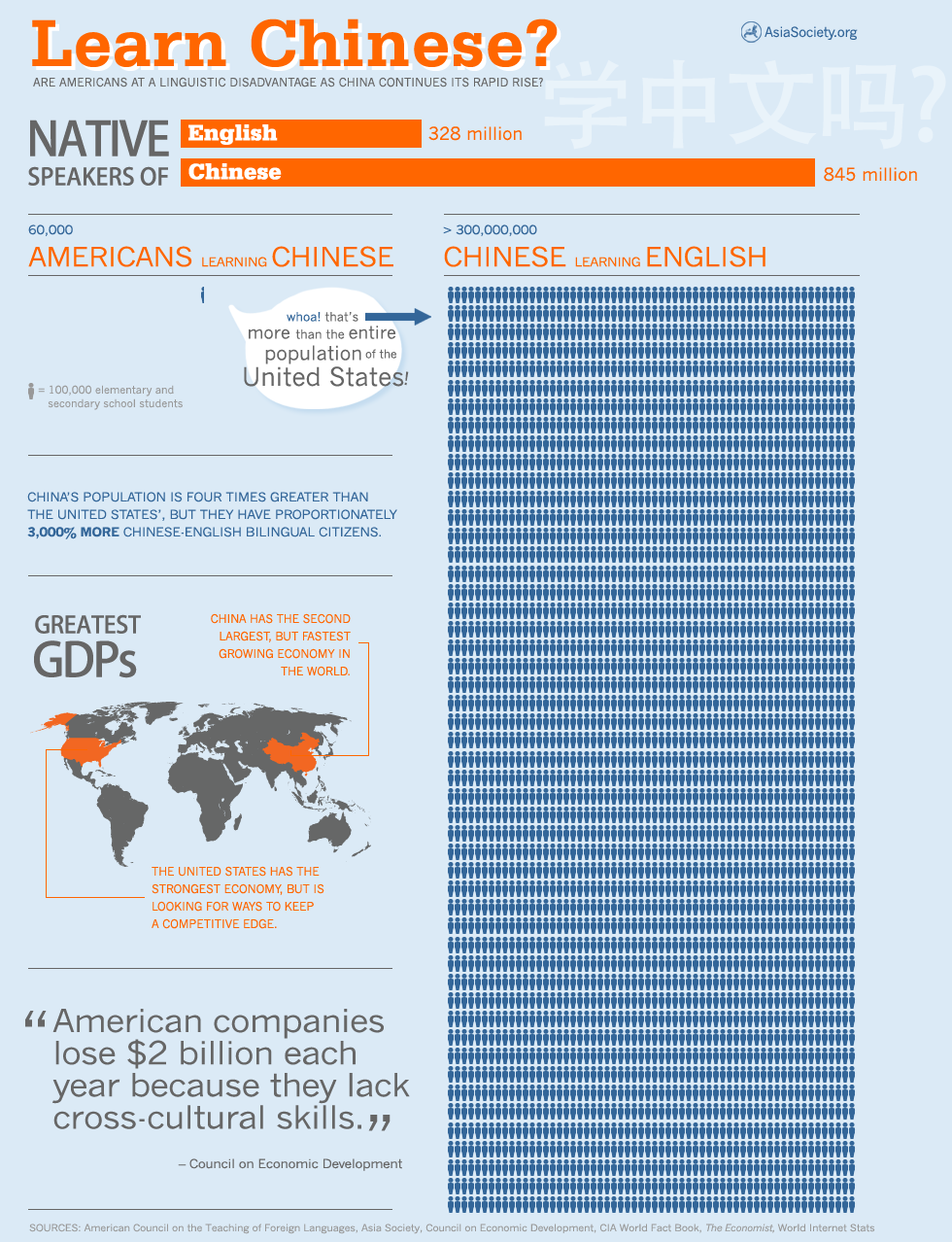
A Graphic for Thought: Learning Chinese

Here's a little pic I found online. Gives at least some impression of our backwardness as Americans. Remind me again why we don't really study foreign languages in America?

http://asiasociety.org/files/infographic-learnchinese.png

The note at the bottom kills me too. Although you can learn a language and do better, learning a language and learning a culture are not coterminous. It helps, and it's a great start, but you need much more than vocab and grammar to know a culture.

Thursday, December 9, 2010

Mostly on Modesty

Does it bother you when you can see a woman's bra through her blouse? Or a dude's underwear or 'crack' when he bends over (or when he's just standing there)?

Language can be a funny thing, especially when translating something from one language and culture to another. Just one of the many idiosyncrasies between Chinese and English is the word Modesty.

In English one of the first things I think of when I hear modesty is physical appearance in relation to clothing (and, I would add, more often in relation to women's clothing). It can certainly take the form of behavior or attitude as well (as a synonym for humble). For example:

"Is this dress modest?"
"What about this swim suit?"
"That guy is really immodest, he's always talking about how great he is."

However, when speaking with Chinese students about modesty (in English) the first thing they usually think of is humble/not humble. The root word 谦 (qian) is translated 'modest', but the basic meaning is humble. Here's a few examples drawn from my little iPod Pleco dictionary:

谦卑 - qianbei: humble, modest

谦虚 - qianxu: modest, self-effacing; make modest remarks

谦逊 - qianxun: modest, unassuming

And not one of the 36 entries for 'modest' had any connotation to physical appearance. It makes me wonder what word(s) my Chinese friends would use to describe 'humble attire'.

Fashion can be a big deal among college students in China. This is encouraged by the proliferation of fake goods that give an impression of wealth and status (not to mention that popular brands often make attractive clothing). Traditional Chinese culture is usually recognized as being modest, both in the unassuming sense and the 'not flaunting of physical features' sense. However, students have begun to experiment with fashion since China began to open up to external influences in the 80s.

Today it is not unusual to find students, particularly girls, wearing some really racy things, and usually below the waist. It is less common to see chest-skin, and I have heard others note that this is more typical in Asia generally. But that doesn't stop the issue altogether. Very thin, light colored sweaters or shirts over off-color or dark bras is very common. Skirts that work better as belts (maybe that's a slight exaggeration), tights worn as pants.

Once, five years ago, I was walking with a friend to the soccer field to kick the ball around and we were dumbfounded to see a girl standing at a phone booth (yes, they still have them in China) wearing a skirt made of that netting normally worn under a dress to make it more poofy. It was like wearing a saran-wrap skirt!

Add to that, there's an extreme issue of not knowing how to wear a skirt, long or short. You can regularly see girls and old ladies squatting down in a skirt, giving full view to everyone what color underwear she's wearing. Once, in class I was trapped in the far corner of the room while teaching because a girl was sitting in a skirt with her legs spread apart. I was so embarrassed, but I couldn't say anything or she would have been mortified.

However, I will stand up for many young girls in China. Many of them still dress with healthy modesty. And, I would argue that many of them really don't know the difference between modest and not, because they've never been taught. Their mother's never wore anything like what's offered in the stores today, and their fathers probably don't care as long as they get married off before they're 30. (There's a saying in China, particularly in rural areas, that girls are like spilt water. I'll blog about that some other day)

This morning I was reading a blog by Michael Hyatt, the CEO of Thomas Nelson Publishing House, and he was talking about his surprise at the lack of modesty on TV, the MTV VMA awards in particular. He gave four guidelines that I hope can be proliferated among the young, in America and China.

Here they are: “Four Guidelines for Modesty”:

  1. If you have trouble getting into it or out of it, it is probably not modest.
  2. If you have to be careful when you sit down or bend over, it is probably not modest.
  3. If people look at any part of your body before looking at your face, it is probably not modest.
  4. If you can see your most private body parts or an outline of those parts under the fabric, it is probably not modest.
Not rules, but good guidelines. Thanks Michael.


What about you? What does modesty mean to you?

Tuesday, December 7, 2010

From the Classroom: Lying

Here's my latest translation, less commentary - more comments below.

他和她是在一个晚会上认识的。那时的
又年轻又美丽,有很多的追求者,而他却是一个穷大学生。可是他却一下子爱上了她,尽管他明明知道自己配不上她。晚会结束的时候,他勇敢的邀请她一块去喝咖啡,她呢,尽管很吃惊,然而出于礼貌,还是答应了。
They met at a party. At that time she was young and beautiful, and she had many pursuers. But he was a poor college student. But after a short while he fell in love with her, even though he clearly knew he was not a good match for her. As the party came to an end he bravely asked her to go with him to a coffee shop. She, although surprised, was very polite, and accepted.

[Good start to a story. Boy, girl, meet at a party, and he's a stud! Although he knows he's only a 3 on the scale and she's a 9, he goes for it...]

坐在咖啡馆里,两人之间的气氛分明很不自然,没有什么话题,咖啡还没上来,她就希望快点二结束。
Sitting in the coffee shop, the atmosphere between them was unnatural, with nothing to talk about and the coffee had not yet come. She desperately hoped that the time would end.

[Things look a little grim for our poor, homely college student...*dramatic rise in music*]

正在这时,服务小姐把咖啡端上来了,他结结巴巴的对服务小姐说:“麻﹑麻,麻烦您那点儿盐过来。”她和那位服务小姐一样大吃一惊,别的客人的目光也一下子集中到了他的身上,他的脸一下子红了,小声说:“我﹑我喝咖啡习惯放点儿盐。”小姐把盐拿过来,他在咖啡里放了点儿盐,慢慢的喝着。她很好奇地问:“你为什么要放盐呢?”他沉默了一会儿,然后红着脸结结巴巴的说:“小﹑小时候,我家住在海边,我老是在海里泡着,海浪打过来,海水进到嘴里,又苦又咸。我已经很久没回家了,真怀念那里的一切,包括那又苦又咸的海水。之所以喜欢在咖啡里放盐,可能是因为想家吧。
Right at that time, the waitress came carrying the coffee, and he stammeringly said to her, "puh-puh-please bring me some salt." The girl and the waitress were quite surprised, and everyone else in the coffee shop turned their gaze to him. His face turned red, and he quietly explained, "I, I, it's my habit to drink coffee with salt." The waitress brought the salt, and he put some in his coffee, drinking it slowly. She was very curious and asked, "Why do you put salt in your coffee?" He sat silent for a while, then stammering, and with a red face said, "When, when I was small, I lived by the sea, and I would always walk along the shore, and when waves would come the spray would get on my mouth, it was so bitter and salty. I haven't been home in a very long time, I really miss it, including the bitter and salty sea water. So when I put salt in my coffee, it's because I miss my home."

[The story reaches a climax. He's bungled his way through things so far, and just at this moment it seems all hope is lost.]

太令人感动了,因为这是她第一次听到男人在她面前说自己想家。她认为想家的男人肯定是爱家的男人,爱家的男人一定是有责任心的男人。她忽然觉得两个人的距离一下子拉近了。于是她也跟他说起了远方的故乡......两个人聊了很久很久,越聊越高兴,不知不觉到了咖啡馆关门的时间。当他提出送她回家时,她竟然没有拒绝。

She was so moved, because this was the first time she had ever witnessed a guy saying he missed his home. She believed that a guy who misses his home is a guy who loves his home, and a guy who loves his home is a responsible man. She suddenly thought these two distant people could be pulled close together. Then she told him a story from a distant place......Two people talked for a long long time, and the more they talked the happier they were. Without hardly noticing, closing time for the cafe arrived. He proposed they return to his apartment, and she unexpectedly did not refuse.

[But somehow he pulls it off and she falls for him! Unfortunately, the story seems to take a disappointing turn, as she follows him like a lamb to the slaughter, to his apartment. And if he's a college student it's his dorm room. Doubly lame.]

从那以后,两个人频繁的约会,她发现他真的是一个很好的男人,大度﹑细心﹑体贴,有很多优点。她暗暗的想:幸亏当时的礼貌,才没有和他错过。后来他们去过了城里的许多咖啡馆,每次她都对服务员说:“请拿点儿盐来好吗?我的朋友喜欢在咖啡里放盐。”

From then on these two frequently met together. She discovered that he really was a very good guy, magnanimous, careful and attentive, and considerate, with many 'advantages.' She secretly thought to herself, 'Thanks to my politeness at that first meeting I didn't miss out meeting him. They went to a great many coffee shops in the city, every time she would ask the waitress, "Please bring some salt. My friend likes salt in his coffee."

[We see that things seem to turn out well for these two.]

再后来,就像童话书里写的一样,“王子和公主结了婚,从此过着幸福的生活。”他们确实过得很幸福,而且幸福地过了四十多年。尽管四十多年中发生了很多变化,但是他们之间的爱从来没有变过,不管是富有还是贫穷,始终相爱,一直到他得病去世。
After that things went just like in the story books, "The prince and princess were married, and lived happily ever after." They were truly happy, and happy for more than 40 years. Although through the 40 years many things changed, the love between them never changed, whether they were rich or poor, from beginning to end, until the day he got sick and died.

[And, the story book ending...or middle part. And, like so many Chinese movies it has a very strange ending. Things seem SO good--and then he dies! What!?]

故事似乎应该结束了,如果没有那封信的话。
It would seem that the story should end there, but that would leave out what the letter said.

[But! It doesn't end there. He wrote a letter from his death bed.]

那封信是他写给她的遗言:“亲爱的,原惊我欺骗了你四十多年。还记得第一次请你喝咖啡吗?当时我太紧张了,不知为什么,竟然对小姐说拿些盐来,其实我喝咖啡从来不放盐。当时既然说出来了,就只好把盐放进去,没想到竟然引起了你的好奇心。这一来,让我喝了半辈子加盐的咖啡。好多次我都想告诉你,可是我怕你不原谅我说谎。我必须用一生去实践这个谎言,不然你可能会离开我,但是我不能没有你。可是,我现在不怕了,因为我就要死了,死人总是很容易被人原谅的,对不对?今生得到你是我最大的幸福,如果有来生,我还希望娶到你,即使再喝几十年加盐的咖啡,也没关系。不过说实话,咖啡放盐简直太难喝了。咖啡里放盐,当时我是怎么想出来的呢?”
The letter he gave her were his last words: "My dear Love, forgive me for deceiving you more than 40 years ago. Do you remember the first time we met? I was so nervous then! I don't know why, but I even surprised myself when I asked the waitress to bring salt. I actually have never liked salt in my coffee. At that time I would never have imagined it would lead to your curiosity. I only drank half the cup. Many times I wanted to tell you, but I was afraid you would not forgive my lie. My whole life I have had to perpetuate this lie, otherwise you would leave me, but I can't live without you! However, now I am not afraid, because I will soon die, and dying people are easy to forgive, right? In this life you have been my greatest blessing, and when I enter the next life, I hope marry you. And even if I have to drink salty coffee for another 40 years, it doesn't matter. To tell you the truth, salty coffee is really hard to drink! Salty coffee, how could I think of something like that?!

[It reads...blah blah blah. "I'm a liar, have been my whole life. And I didn't trust you enough to share my deepest longings and fears. But now that I'm dying I can spill everything. It might leave you miserable, but at least I'll feel good about myself, having spilled it all. Then I can die and leave you." (this is my sarcastic voice, can you hear it?) "And I'm an idiot for drinking salty coffee for more than 40 years."]

信的内容令她大吃一惊,她多想流着泪告诉他:“她是世界上最幸福的人,因为有人为了她,能够用一辈子去实践一个谎言。”
The contents of the letter really surprised her, and she cried very much, telling him: "'She' is the most blessed woman in the whole world, because for her sake a man would perpetuate a lie for his whole life."

[This is the part that got me the most. She was the most blessed person in the whole world because he was so insecure that he would perpetuate a stupid lie for his whole life. Are you kidding me? How is that a good thing?]

The end.


Comments. I was annoyed when I read this story. When I was teaching English, every year I would prepare at least one lesson on lying. It's epidemic here. It goes hand in hand with cheating and plagiarism. And it seems only a few people bat an eye at it. Many times students would say, "what's wrong with a little white lie?"

One of the more interesting 'white lies' that continues to circulate is the melamine in milk issue. The initial 'outbreak' was years ago. But it continue to crop up. How is that possible?

At the same time, I am constantly reminding myself that this is not isolated to China. Just read the news from Capitol Hill, or watch a sitcom, or (I dare you) look at your own life. How often do we just cover up our goofs with our bluffs. It's part of American culture too. It would be all too easy to read this story and my past experiences, and start pointing fingers at 'them'. But that would be a lie.

The only antidote is an encounter with the Truth, the Light that brings all things out in the open.

Saturday, November 13, 2010

Life Direction, Advent and Tutoring

I have a Chinese tutor. I named him Louie (his surname is Lu, so it seemed to fit well, and he liked it).

He has been a good source of encouragement to me these past days. A week or more ago he was first to our room that we've been meeting in and when I walked in he asked how I was doing. I said good, the weather was warm and sunny, I was feeling good about studying at the time. Then I asked how he was doing. He said, eh, just ok. I asked why and that launched us into a lengthy discussion about life and big decisions, etc. He spent all of last year in Pittsburgh at a Confucian Institute, teaching Chinese to "foreigners" (I like to keep the label, even though he was the foreigner at the time). I was excited for him to return. He'll graduate this coming July with an M.A. in Teaching Chinese, so he's got mad skilz, always comes prepared, and he's just enjoyable to hang with.

He was troubled on this particular day, wrestling with considerations of a PhD, getting a job after he graduates, etc. He asked me how I made and make my decisions regarding these things since I'm in China now, doing an M.A., with plans for a PhD, having somewhat recently gotten married, etc. This opened the door to a really great conversation about following my Lord, how He cares for us, how I talk with Him and hear His voice. He asked some fairly perceptive questions, like "wow, that's great, would he do the same for me?" Another cool part of the story is that it was all done in Chinese! I would say it was my first really significant conversation in Chinese (beyond, where are you from, how old are you, how much money do you make, are you married, how long have you been in China...wow! Your Chinese is really good!).

Then, yesterday he came to the apartment to tutor me. I was working on an Advent Reading Calendar for the family, a tradition we tried last year and wanted to do more of this year. By the way, if you'd like a copy I should have it done by middle-ish of next week, and I can email it out to anyone who wants it. I'll let you know when it's prepared.

He came in and asked what I was up to, and I said I was working on and Advent Calendar. He had never heard of it, so I brought him over to the computer and showed him what I had done. I tried to explain how each reading is significant, and we looked at one. The second day I titled: Brokenness and Healing. I read Isaiah 52:13-53:12 and explained how it refers to the future events in the life of Jesus, and what impact that has on our life. (side note: this time it was done in English...) He was impressed. He said, "I think I need to get [this book] and read it myself." I said, "that's a great idea! How about I bring you one next week?" He said, "Yeah, that's cool."

We'll see what comes of this. More later...

Wednesday, November 10, 2010

Ups and Downs

Wow! It's hard to put into words the ups and downs you can feel in language study, and living cross-culturally in general. Here's a snippet.

Monday and yesterday I was feeling pretty bummed about my Chinese. Really, quite DOWN. It's not uncommon on days like those to think, "Am I just wasting my time here? What if I completely stop remembering characters, and I fail all my classes? I'll return to the States with my tail between my legs and go to flipping burgers or something..." I felt like my Chinese is just so-so after more than a year studying (Chinese has a great word-phrase for so-so: mamahuhu 马马虎虎, which, when translated literally, comes out horse-horse-tiger-tiger).

Here's how the day went. I had Comprehensive for two periods (a period being 45 min), then Oral for two periods; and my morning is spent. Comprehensive went well enough, just kind of went through it. Oral, we had a kind of mock midterm exam. We were supposed to have previewed two texts by reading and listening to an audio of them, and have done all the practice work for chapter seven so that we can speak the chapter problems and texts very fluidly. I listened to the first text a few times and read along, and listened a few more times on my way to class early this morning. No fluidity happening here.

In Oral class the teacher took attendance on the media projector, and then proceeded to have students read parts of either one of the two texts or the practice problems. He would then write the score he thought the student should have, based on their speaking. Some students whom I think generally better than me scored 60s. I was...a little bit nervous. He came to me and asked me to read from the second text (which I had not even glanced at). Thankfully it was not full of a whole bunch of new words. I, along with my North Korean neighbor (I'll definitely blog about him another time, so stay tuned), and the only other American in the class all read from the second text, and we all scored 95s. That felt very good. Very very good. [the text that I HAD studied was one of the more funny and interesting ones; I'll be posting it with my translation and commentary as soon as I can get it done]

The weather being INCREDIBLY beautiful today, my tutor and I walked around campus, attempting to work out a couple of things-a library card for me, and a question for a friend-and we sat on the grass in the warm sun and just talked for over an hour. Nearly all in Chinese. That felt good too.

As I said before, I had my first midterm today, in writing class. I hardly prepared, but I reviewed a few characters that I knew would be important. Three parts: writing a note, an email, and an introduction of a friend I am familiar with. I chose my N. Korean neighbor, and he chose me. It worked out well, and I feel good about it.

Then I walked home to a blazing orange sunset. I walked along a paved path through a large grassy area (there are not really very many of these in China, so its exceptionally enjoyable); people sitting on benches, roller bladers, little babies in split-pants, and four old men flying kites. There are almost always old men flying kites in the Quad (so-called because it's somewhat of rectangular area). These old men had their kites waaaaay waaaaaay out there--little specks in the distance--I would guess a half-mile away, maybe even more. And as I walked in the sun, with awesome blue sky above (also somewhat rare), I looked at one of the old men with his kite way off in the distance, and he looked at me. He wasn't smiling, not grumpy, not sad, just kind of a blank stare. I busted out my biggest grin for him, and he smiled back! And my heart was warmed.

And even once more, after I crossed the heinous intersection at the main gate of our school and on past all the various construction projects that are going on right now, I smiled at a worker pushing a wheelbarrow of sand, and he gave me a nice big smile too.

And...I'm up again.

Tuesday, November 9, 2010

A Taste of Chinese Class

Here’s a little taste of Chinese class for your enjoyment. You can really learn a lot about a culture by studying it’s language textbooks. What do you gather from this?.....
[and I have commentary in brackets like these]

小林:爸爸,有朋友请我参加平安夜舞会,今天晚上我就不回家了。

Little Lin [pronounced: Leen]: Baba, my friend invited me to celebrate a Christmas Eve Ball, so tonight I won't becoming home.

[Christmas Eve in China is a KAY-RAZY time. Imagine a carnival on steroids, all up and down the streets. All kinds of street food, balloons, flowers, and one BILLION of your closest friends all jammed together on the streets and sidewalks.]

爸爸:什么?一晚上不回家?这些洋节有什么好?我真是不明白你们这些年轻人。

Baba [means Dad; but I like the 'flavor' of Baba better]: What?! You won't come home tonight? What is good about these foreign holidays? I really don't understand you young people.

[in China the age-gap between generations is enormous. I've heard that every five years is considered a new generation, especially among the younger crowds. Students who graduated five years ago can hardly make sense of college students today, their worldviews and experiences are so far apart.]

小林:我也说不清楚,只要是节我就过,反正就是高兴,可以乘机放松放松。

LL: I'm not too clear about it either, only I like to celebrate these holidays, they're really fun, and I want to seize the chance to relax a little bit!

爸爸:放松?那为什么过春节,中秋节没见你这么高兴?传统节日不也挺热闹吗?

BB: Relax?! Why doesn't celebrating Spring Festival and Mid-Autumn Festival make you happy? Traditional holidays aren't lively enough?

[Spring Festival, usually in February and based on a lunar calendar, and Mid-Autumn Festival, also lunar, are traditional Chinese holidays.]

小林:传统节日也不错,不过,传统节日净讲究“团圆”,全家人在一起不是吃饭就是看电视,没什么意思。

LL: Traditional holidays aren't bad, but, traditional holidays merely focus on "family reunion", getting the whole family together to eat food or watch T.V.

[This is really quite true. When my wife and I visited a friends home for Spring Festival pretty much all we did was eat food and watch T.V. For Spring Festival there is the obligatory house cleaning and a few other small things, but not much else.]

爸爸:什么节你不也一样玩吗?再说,一家人团圆有什么不好?

BB: Are there any holidays that are not equally as fun? Besides, what's so bad about family reunions?

[Family is huge in China. It can be a huge insult to dislike family reunions, not to mention a turning from literally thousands of years of history]

小林:可能洋节更接近年轻人的性格吧,向干什么就干什么,什么规矩都没有,什么情人节,圣诞节,万圣节,都浪漫,都刺激啊!

LL: Maybe foreign holidays are more close to young people's disposition? If we want to do something, we do it, and there's no rules. Valentines Day, Christmas, Halloween, they're all romantic and stimulating!

[Word choice here was a little tricky, the last word in particular. It really literally "stimulating", but I think the idea conveyed is exciting. And, there's a very strong "foreign/Chinese" aspect at play through the whole dialogue, as in Chinese culture in general. The older people defending the traditions and the younger people accepting...well, pretty much anything, and often without much consideration. As he says, if we want to do something, we do it, and there's no rules! I've never heard of a holiday anywhere that had NO rules. Ridiculous!]

爸爸:这倒也是,洋节的过法和传统节日的过法还真不一样,连商场的气氛都不一样。

BB: I see your point. Foreign holiday celebrations and traditional holiday celebrations are very different, even the atmosphere in the markets is different.

[Here Baba is conceding a point, that there is something to those foreign holidays.]

小林:是啊,您在看看报纸,电视,广播,能不吸引人吗?

LL: Yeah! When you read the paper, watch T.V. and listen to radio broadcasts, you can't help but be influenced, can you?

[It is interesting to note that, although the Little Lin is incredibly rebellious throughout the dialogue, he continues to address Baba with the more respectful term, nin 您, rather than the casual ni 你.]

爸爸:热闹是热闹,不过,你知道这些洋节是怎么来的吗?

BB: Excitement is excitement, however, do you know where these foreign holidays come from?

[A little Chinese grammar: the first five characters are an admission of something, agreeing that it's true, but indicating that you have some reservation. You can see it's followed by 'however'... The more direct translation comes out a little wooden, but I thought you might enjoy a little 'Chinese flavor'.]

小林:不知道,我也不想知道,我就想好好玩儿玩儿,还有情人节,母亲节什么的,大家都过,我也凑凑热闹。就好像没有情人也可以过情人节一样,我管它是情人节还是愚人节呢,过节就是给自己找一个快乐的理由。

LL: I don't know. And I don't wanna know! I just want to have fun, and Valentines Day, Mother's Day, etc., I celebrate them all, and join in all the fun! Even if I don't have a girlfriend I can still celebrate Valentines Day. Whether it's Valentines Day, April Fools Day, they all give me a reason to look for happiness!

[Here our little friend shows a little more color. Not only does he not know where the holidays come from, he doesn't care. And we see again, nothing matters but having fun.]

爸爸:其实,咱中国也有情人节啊,还不止一个呢,三月三,七月七不都是吗?我觉得那洋情人节就不怎么样,咱中国活里头“情人”就不是个好词,我还看见,214日那天,有个饭店门口竟然立了块牌子,写着“非情人莫入”,也太过分了!

BB: Actually, Our China also has Valentines day, and not only one! March 3rd, July 7th, both are, aren't they? I think that foreign Valentines Day is not even worth talking about. In Our China lives "lover" is not a good word. AND! On February 14th, quite to my surprise, I saw a restaurant with a sign on it's door, that read "No Lover No Enter"! So uncalled for!

[I really got a kick out of translating this one. A few notes:

1. As foreign teachers talking with students, or just when you talk with anyone in English, unless they are pretty good with their English skills, will say Our China, which is a direct translation from the Chinese. It's an aspect of Chinese culture that is a little far removed from "Our American" lives. But it's Chinese culture. They find a healthy sense of identity in the group. So they use the plural.

2. And yes, China does have two Valentines Days. The first one is on March 3rd, the second on July 7th. And the dates aren't random either. In Chinese the months don't have names, they're just in order by number. So March is sanyue 三月, literally Three Month, and July is the same, qiyue 七月, Seven Month. So the date comes out 3.3 and 7.7. Chinese culture is particularly bonkers about numbers. Eight is also a very 'lucky' number. That's why the Beijing Olympics started on 8.8.2008 at 8:08pm. Pretty cool, huh? If you're bored you can learn more about the two different Valentines Days here and here.

3. I made the sign on the restaurant door a little Chinglishy, just because I can see it happening like that. Call it translators prerogative. It's also how the Chinese comes out, very very directly. But it wouldn't sound like that to Chinese ears.

4. "Lover" was also a funny translation. It's not uncommon for students to talk about their 'lover'. It's far far too late to try and correct the issue, though we attempt it from time to time with friends, explaining that 'lover' is usually used when referring to the woman a man or woman is sleeping with other than the man or woman's spouse. Then they go, "OH!!!!!". Yeah. And, one time Emily got an email from someone at the company asking if she could take her 'lover's' passport to the office for something. We got a kick out of that. And, yes, she is my lover, my only lover. Emily and I also thought it was funny that Baba says it's not a good word in China. But people use it here ALL THE TIME. All the time. Though, perhaps not among the older folks. I need to talk with them more, and find out.]

小林:哎呀,您那么认真干吗呀!我倒觉得节是越多越好,传统节咱也过,那是属于咱们全家的,外国节,我也过,那是属于我自己的,您看怎么样啊?

LL: Aiya! Why do you care about this so much?! I admit, celebrations are getting better and better -- traditional holidays we all celebrate, they're for the whole family; foreign holidays I also celebrate, they're for myself. OK?

[Aiya! - a very common expression, usually of exasperation. And more sass from Little Lin. He gives into Baba's pressure to include the traditional holidays in his effort at 'self-expression'. And he ends it with a question that is polite in form, but shows his frustration. It comes out more literally, 'How do you see that?', but it's basically saying, "see, I give in a little, so get off my back!", and he again uses the more polite nin, 您]


I hope you have enjoyed this tour through a Chinese text and culture today. If you have questions, please refer to my Contact Me page on this blog... :p