Here's an interesting translation of an article reflecting on the 1911 revolution (that started in Wuhan!), that was just celebrated in China. It also has a fairly lengthy discussion of Confucianism in relation to politics. Check it out:
100 years after the Xinhai Revolution
And another blog with a wider range of coverage:
A Century After Xinhai: Who's Revolution?
Friday, October 14, 2011

Friday, September 23, 2011
Contemporary Culture and Classical Chinese Philosophy at a Cross-Roads
I just read an article this morning that really revved me up. You can
read the whole article here.
The article addresses the response of some Chinese to recent newspaper articles criticizing the new ambassador from the U.S. to China, Gary Locke. A Communist party newspaper, Guangming Daily, accusing the U.S. of using Locke's Chinese-American identity to seduce the Chinese people and subvert the government. But online response to the newspaper article turned the critique in an unexpected direction.
As an advisor to the king, Mengzi tells a story of one T’ang. He was so virtuous and practiced such benevolent leadership over his people that, when he went to war against a tyrannical king in the east, the people in the west complained that he did not come to them first and relieve them of their oppression. And when he went south, the people in the north complained that he did not come to them first.
The article addresses the response of some Chinese to recent newspaper articles criticizing the new ambassador from the U.S. to China, Gary Locke. A Communist party newspaper, Guangming Daily, accusing the U.S. of using Locke's Chinese-American identity to seduce the Chinese people and subvert the government. But online response to the newspaper article turned the critique in an unexpected direction.
Two
quotes from the web summarize an attitude I am quite sure was not the intended
response of the newspaper:
"To be honest, I’m looking forward to being colonized," a user of China’s popular Sina Weibo microblogging service writing under the name Yan Lu’antong commented Tuesday. "We welcome this kind of ‘neo-colonialism’ with open arms!!!" added another user, Liu Xiaodong.
There
is an interesting parallel in Mengzi (Mencius) (you can read the text at the
bottom of this entry). The main gist is this:
King Hsuan saw the tyranny of Yen over his people and decided to overthrow
his power and relieve the people of their suffering. Then, after King Hsuan had done so, he
proceeded to inflict his own oppression on the people. The feudal lords of that area decided to stop
King Hsuan. He asks Mengzi what he should do in this situation.
As an advisor to the king, Mengzi tells a story of one T’ang. He was so virtuous and practiced such benevolent leadership over his people that, when he went to war against a tyrannical king in the east, the people in the west complained that he did not come to them first and relieve them of their oppression. And when he went south, the people in the north complained that he did not come to them first.
The
point is, when people are suffering under a bad government, they long for
someone to relieve them of their suffering, and might even be willing to accept
it from an outsider, a foreigner. They don’t
mind if he invades their country, and they even welcome it with open arms,
offering gifts with gladness.
If
there are some here who would welcome with open arms the ambassador of
another country, what does that say about the situation here, and the
people's sentiments about their rulers? It would seem there are some (and I would not say even a majority, just some) in this country would would echo the words of the western and northern barbarians, "Why don't you come to us first?".
I would add, though, that they are more than likely being sarcastic, and
if the U.S. were to actually send men in uniform there would be quite a
different reaction, even from these Weibo-ers (Weibo is the Chinese version of
Twitter; for an interesting commentary on Chinese social media and I think
social media in general, check out this bit o’ journalism on the world’s second
most influential person of 2010, according to Time magazine).
This
passage in Mengzi also has interesting implications for the U.S. government, as
it pursues its international policy of invasion and reform in other countries
like Iraq and Afghanistan. Perhaps many
people initially welcomed them with open arms, and many have found relief. But what is the response of the people in those
countries now? Certainly the U.S. has
done many good things like built schools, hospitals, and other humanitarian
projects, and the issue of carrying out reform while fighting violent insurgents
is complicated, but what legacy will be left behind? How will the people remember these past 10+
years? And what is the ideological foundation for
such an international policy?
Here
is the text of the Mengzi passage, found in Mengzi 1B.11:
The men of Ch’i attacked and annexed Yen. The feudal lords deliberated how they might go to the aid of Yen. King Hsuan said, "Most of the feudal lords are thinking of going to war with me. In what way can I stop this from happening?""I have heard," answered Mencius, "of one who gained ascendency over the Empire from the modest beginning of seventy li square. Such a one was T’ang. I have never heard of anyone ruling over a thousand li square being afraid of others."[Mengzi continued,] "The Book of History says,T’ang began his punitive expeditions with Ke..With this he gained the trust of the Empire, and when he marched on the east, the western barbarians complained, and when he marched on the south, the northern barbarians complained. They all said, “Why does he not come to us first?” The people longed for his coming as they longed for a rainbow in time of severe drought. Those who were going to market did not stop; those who were ploughing went on ploughing. He punished the rulers and comforted the people, like a fall of timely rain, and the people greatly rejoiced."[Again, Mengzi said,] "The Book of History says,We await our Lord. When he comes we will be revived."Now when you went to punish Yen which practiced tyranny over its people, the people thought you were trying to rescue them from water and fire, and they came to meet your army, bringing baskets of rice and bottles of drink. How can it be right for you to kill the old and bind the young, destroy the ancestral temples and appropriate the valuable vessels? Even before this, the whole Empire was afraid of the power of Ch’i. Now you double your territory without practicing benevolent government. This is to provoke the armies of the whole Empire. If you hasten to order the release of the captives, old and young, leave the valuable vessels where they are, and take your army out after setting up a ruler in consultation with the men of Yen, it is still not too late to halt the armies of the Empire."
translation by D.C. Lau
Monday, September 5, 2011
First Semester of the MA, Course Schedule
I'm in the process of getting registered for the first semester of classes in the Chinese Philosophy M.A. program. Talk about freaked out. Looking over the two years of classes I'll have to take, I need a total of 28 credits, plus writing a thesis, in Chinese.
Here's what the first semester is shaping up to:
Monday
2:00-4:30pm - Questions in Ruism (commonly known as Confucianism, a misnomer from the Jesuits in the 16th C.)
7:00-9:25pm - Methods and Questions in Philosophy
Tuesday
No Class (really, study extremely hard for what I didn't get yesterday!)
Wednesday
2:00-4:30pm - Song (with an 'oh' sound, not an 'ah' sound) and Ming Dynasty Neo-Ruism
7:00-9:25pm - Readings in Marxism (yes! I'm stoked to hear a different perspective on this. Definitely updates on this later)
Thursday and Friday
Try to catch up from the week.
Saturday
2:00-4:30pm - Readings in Western Philosophy (this class will actually be taught in English, and I think papers, etc are also in English! Whew!!! ONE small moment to 'relax'.)
Sunday
REST!
There's a possibility I'll take up Japanese as well...but I have to wait and see how this course load goes. Maybe next year...
Here's what the first semester is shaping up to:
Monday
2:00-4:30pm - Questions in Ruism (commonly known as Confucianism, a misnomer from the Jesuits in the 16th C.)
7:00-9:25pm - Methods and Questions in Philosophy
Tuesday
No Class (really, study extremely hard for what I didn't get yesterday!)
Wednesday
2:00-4:30pm - Song (with an 'oh' sound, not an 'ah' sound) and Ming Dynasty Neo-Ruism
7:00-9:25pm - Readings in Marxism (yes! I'm stoked to hear a different perspective on this. Definitely updates on this later)
Thursday and Friday
Try to catch up from the week.
Saturday
2:00-4:30pm - Readings in Western Philosophy (this class will actually be taught in English, and I think papers, etc are also in English! Whew!!! ONE small moment to 'relax'.)
Sunday
REST!
There's a possibility I'll take up Japanese as well...but I have to wait and see how this course load goes. Maybe next year...
Monday, August 29, 2011
A Dream of Chinese Mansions
What is the Chinese dream? What are they aiming for?
My good friend Jason's comment on an earlier post got me thinking about this question. He wrote:
There have been a lot of online articles writing on the Chinese dream, and even a book with the same title that came out last year. Here's a little of what I found:
- The Family Planning Policy ('One Child' Policy is a huge misnomer, for another post) has created a large segment of young people without brother or sister. And for those who can find a decent job straight out of college or even six months later, many of them seek to model themselves after their "big brother", Americans. You can find them sipping a latte in Starbucks while they surf the Chinese web, wearing the latest fashions, hitting the karaoke bars every week, eating at "Western" restaurants, and doing things that young kids like to do with the disposable income. ("Western" restaurants are those that serve non-Chinese food, with greater and lesser degrees of accuracy, and almost across the board higher prices, thus higher status to be seen eating there)
However, that leaves out a large segment of this same 'young people' population who don't live like there's no tomorrow. They are frugal, wear the same outfits every week, send a significant portion of their paycheck home to their parents, and choose the cheap restaurants or even cook for themselves (my friend cooked a meal for three on less than 2 U.S. Dollars, and we had enough left over for lunch the next day; yay for local markets!).
- Many Chinese have learned to dream from Americans. An article written by the same woman who wrote the book, The Chinese Dream, gave these two quotes as examples:
The perception of the Chinese blogger may not represent MY life, but by virtue of being American I represent that life to them, unless I demonstrate otherwise.
- There's another aspect of 'the Chinese dream' I should have, but did not anticipate, that of non-Chinese coming to China in search of their dream. A lengthy article in the Washington Post highlights the fast growing number of foreigners in China (particularly Muslim), and the benefits that come with it. It reminded me of a 'friend' I have run into irregularly. He's Iraqi, and has lived in Wuhan for 10-15 years now. He did an MA and PhD at Wuhan University, and continued on as a faculty member. He had not once returned to his home country. I asked him why once, and to my embarrassment, he said something to the effect of, "After the U.S. invaded my country there was nothing to go back to."
- Lastly, as some of the articles I read said as well, it's hard to really pin down one 'Chinese dream'. Some are dreaming of leaving behind the mud-brick shack in the countryside for a small place in the big city. Some are hoping to graduate and find a job good enough to make ends meet. Some are hoping to trade in their Buick (it's a luxury car in China) for a BMW. The size , history and diversity of China makes it difficult to pin down one Chinese dream.
But, like Americans, I'd say they all have the dream of bigger, better, faster, flashier, happier, and hopeful. As one Chinese blog wrote:
In response to Jason's honest statement, do we have anything to fear? From Chinese? Perhaps. But no more than those who call the United States a foreign country have to fear from Americans.
My good friend Jason's comment on an earlier post got me thinking about this question. He wrote:
China has a great manufacturing sector, many may soon look to China as an example in business and life. That is scary to me.What kind of an example might the Chinese life be for the 'people of the future', your kids and grand-kids? I'll avoid the business example question, as that's another bear to wrestle with for another time.
There have been a lot of online articles writing on the Chinese dream, and even a book with the same title that came out last year. Here's a little of what I found:
- The Family Planning Policy ('One Child' Policy is a huge misnomer, for another post) has created a large segment of young people without brother or sister. And for those who can find a decent job straight out of college or even six months later, many of them seek to model themselves after their "big brother", Americans. You can find them sipping a latte in Starbucks while they surf the Chinese web, wearing the latest fashions, hitting the karaoke bars every week, eating at "Western" restaurants, and doing things that young kids like to do with the disposable income. ("Western" restaurants are those that serve non-Chinese food, with greater and lesser degrees of accuracy, and almost across the board higher prices, thus higher status to be seen eating there)
However, that leaves out a large segment of this same 'young people' population who don't live like there's no tomorrow. They are frugal, wear the same outfits every week, send a significant portion of their paycheck home to their parents, and choose the cheap restaurants or even cook for themselves (my friend cooked a meal for three on less than 2 U.S. Dollars, and we had enough left over for lunch the next day; yay for local markets!).
- Many Chinese have learned to dream from Americans. An article written by the same woman who wrote the book, The Chinese Dream, gave these two quotes as examples:
Without addressing the whole copying problem in China, the magazine editor's comment gives me pause. What DO they see in the American dream? Certainly its a picture somewhat rosied by Hollywood. But despite accusations that their replication of the American dream is lopsided and incomplete, I would argue that it's not untrue. Even if they only emphasize certain aspects of it, they are emphasizing true aspects of it. This forces me to question some basic assumptions about life, wealth, and the American dream. What dream to I communicate by my actions, choices, purchases (or not purchasing)? What is really most valuable to me? And do my friends see that in how I live? Or are my deepest dreams obscured by the American habits and patterns of living I so easily fall into without a second thought?
As a Chinese magazine editor told me bluntly, “The Chinese Dream is a copy of the American Dream.”
Many middle class Chinese are influenced by the American way of life. They are bombarded by many material temptations and proliferating choices. TV commercials, the Internet, and Hollywood movies give them a rosy picture of the American middle class.
One Chinese blog described it this way: “American middle class people live in a villa with a two-car garage in the suburbs. In front of the house, there is a green lawn. They have 2-3 children, and a dog. The husband goes out to work, and the wife stays at home taking care of the children. On weekends, they drive their SUVs to the countryside for barbecues and camping.”
The perception of the Chinese blogger may not represent MY life, but by virtue of being American I represent that life to them, unless I demonstrate otherwise.
- There's another aspect of 'the Chinese dream' I should have, but did not anticipate, that of non-Chinese coming to China in search of their dream. A lengthy article in the Washington Post highlights the fast growing number of foreigners in China (particularly Muslim), and the benefits that come with it. It reminded me of a 'friend' I have run into irregularly. He's Iraqi, and has lived in Wuhan for 10-15 years now. He did an MA and PhD at Wuhan University, and continued on as a faculty member. He had not once returned to his home country. I asked him why once, and to my embarrassment, he said something to the effect of, "After the U.S. invaded my country there was nothing to go back to."
- Lastly, as some of the articles I read said as well, it's hard to really pin down one 'Chinese dream'. Some are dreaming of leaving behind the mud-brick shack in the countryside for a small place in the big city. Some are hoping to graduate and find a job good enough to make ends meet. Some are hoping to trade in their Buick (it's a luxury car in China) for a BMW. The size , history and diversity of China makes it difficult to pin down one Chinese dream.
But, like Americans, I'd say they all have the dream of bigger, better, faster, flashier, happier, and hopeful. As one Chinese blog wrote:
So what’s the difference between the American dream and the Chinese dream? I think it is more likely a human dream comparatively. Everyone first wants to have a full belly, a warm home and a happy family. Of course some other people pursue love and happiness. However, what is happiness? It is only a kind of feeling. Like I mentioned earlier, different people have different feeling. When you have one coin, you must be eager for another.I think it is fair to say that those with one coin, do, generally, want another.
In response to Jason's honest statement, do we have anything to fear? From Chinese? Perhaps. But no more than those who call the United States a foreign country have to fear from Americans.
Friday, August 26, 2011
A Graphic for Thought: Learning Chinese
Here's a little pic I found online. Gives at least some impression of our backwardness as Americans. Remind me again why we don't really study foreign languages in America?
http://asiasociety.org/files/infographic-learnchinese.png
The note at the bottom kills me too. Although you can learn a language and do better, learning a language and learning a culture are not coterminous. It helps, and it's a great start, but you need much more than vocab and grammar to know a culture.
http://asiasociety.org/files/infographic-learnchinese.png
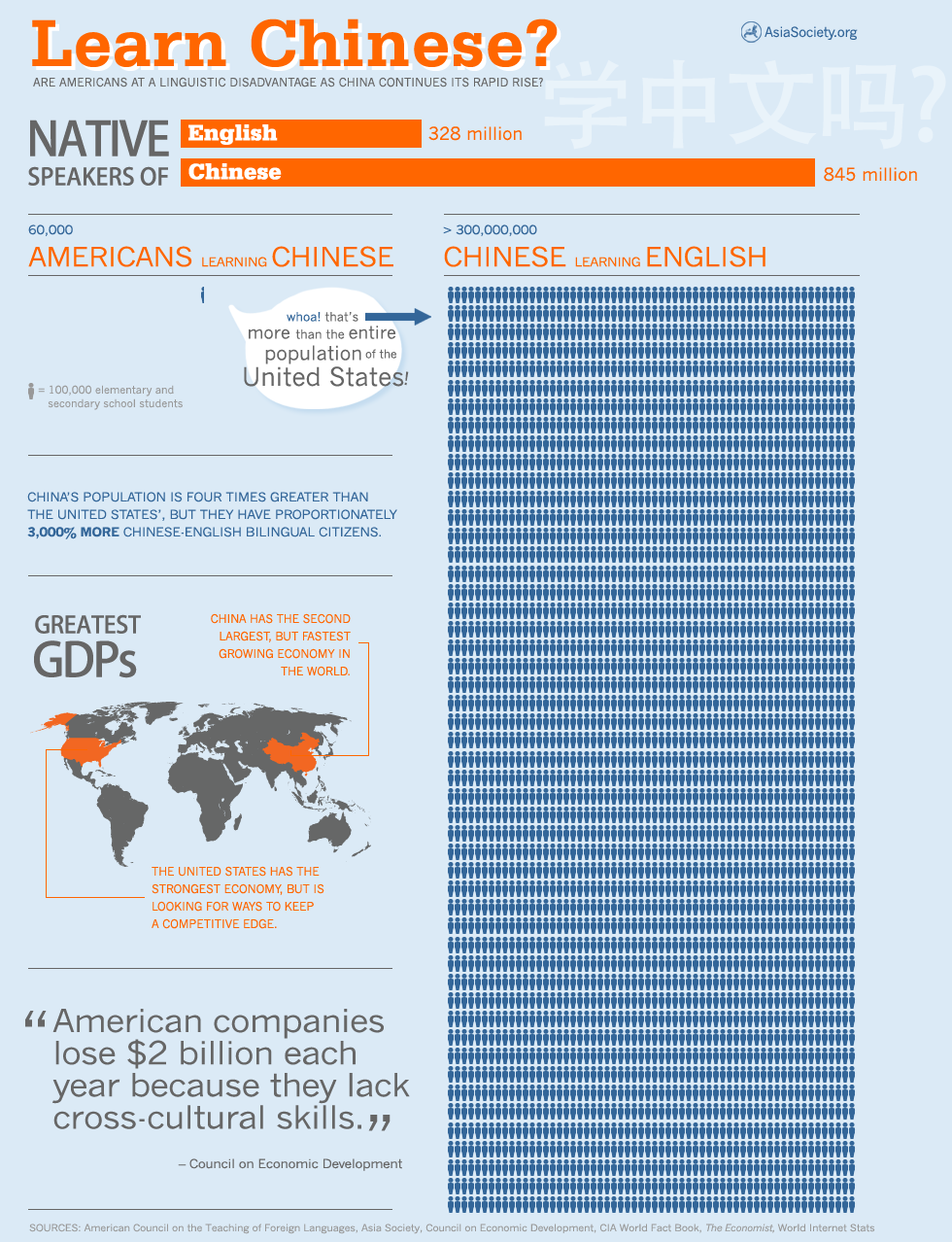
The note at the bottom kills me too. Although you can learn a language and do better, learning a language and learning a culture are not coterminous. It helps, and it's a great start, but you need much more than vocab and grammar to know a culture.
Wednesday, August 17, 2011
History is History, Honesty is Honesty
I haven't posted in 8 months. That's a long time. I won't try to summarize or bless you with little sound bites from the past semester. Just a little story from recent experience.
A couple of nights ago Emily and I went for a walk with a friend of ours. We hadn't seen each other for a while so we caught up on all kinds of things. One of the topics we covered was child raising. There were lots of little tots running around the little park we were walking about in, and our friend had brought her own 20 month old daughter as well, and we are hopeful for children soon, so it seemed like a great topic.
Our friend expressed her concern about raising her daughter according to good ethical boundaries. She used the example of honesty. She said, 'If I teach my daughter to be honest I'm afraid that when she grows up she will be disillusioned about society.'
I share this story to highlight two things. First, a great need in Chinese society for an ethical overhaul. Our friend is not the only one who feels this ethical vacuum. You can talk with any man-in-the-street and they would confirm the same sense, that there is no standard that people generally look to when deciding right and wrong. They all agree there is a need for one, but no one can point to something definite that guides their life. Many Chinese today are struggling for hope in a world where ethical relativism rules the day. What is most important is what is most expedient.
The second thing is a conflict of interest. Generally I think American's would agree that if you're an honest person you can make your way and do well in the world. You don't have an overwhelming sense that you must construct your own reality (i.e. lie) in order to see success, or at least avoid being taken advantage of. This doesn't require you to tell everything to everyone all the time, discretion is acceptable. But you don't have a fear your honesty will bring you sorrow and suffering. We work on the assumption that truth will ultimately win the day.
Can you imagine what life would be like walking out the door each day with your guard up, not knowing if someone was going to take you for a ride, where the stakes were as high as 'lie or lose'?
Perhaps I've lived too long outside the States. I may be naive. Maybe American life is as much an ethical vacuum as Chinese.
What do you think?
A couple of nights ago Emily and I went for a walk with a friend of ours. We hadn't seen each other for a while so we caught up on all kinds of things. One of the topics we covered was child raising. There were lots of little tots running around the little park we were walking about in, and our friend had brought her own 20 month old daughter as well, and we are hopeful for children soon, so it seemed like a great topic.
Our friend expressed her concern about raising her daughter according to good ethical boundaries. She used the example of honesty. She said, 'If I teach my daughter to be honest I'm afraid that when she grows up she will be disillusioned about society.'
I share this story to highlight two things. First, a great need in Chinese society for an ethical overhaul. Our friend is not the only one who feels this ethical vacuum. You can talk with any man-in-the-street and they would confirm the same sense, that there is no standard that people generally look to when deciding right and wrong. They all agree there is a need for one, but no one can point to something definite that guides their life. Many Chinese today are struggling for hope in a world where ethical relativism rules the day. What is most important is what is most expedient.
The second thing is a conflict of interest. Generally I think American's would agree that if you're an honest person you can make your way and do well in the world. You don't have an overwhelming sense that you must construct your own reality (i.e. lie) in order to see success, or at least avoid being taken advantage of. This doesn't require you to tell everything to everyone all the time, discretion is acceptable. But you don't have a fear your honesty will bring you sorrow and suffering. We work on the assumption that truth will ultimately win the day.
Can you imagine what life would be like walking out the door each day with your guard up, not knowing if someone was going to take you for a ride, where the stakes were as high as 'lie or lose'?
Perhaps I've lived too long outside the States. I may be naive. Maybe American life is as much an ethical vacuum as Chinese.
What do you think?
Subscribe to:
Posts (Atom)